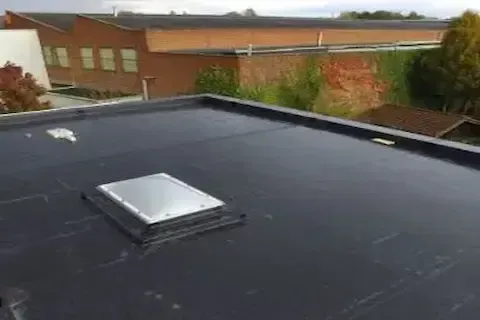
EPDM Winter Performance on Maple Grove MN Cold Snaps
Minnesota winters don't ease into cold — they arrive hard and stay long. For commercial property owners and facility managers in Maple Grove, that means flat and low-slope roofs face months of thermal cycling, ice loading, freeze-thaw stress, and wind-driven precipitation. EPDM membranes have been a dominant choice for commercial roofing across the Upper Midwest for decades, and for good reason. When installed correctly, EPDM holds up remarkably well through the kind of punishment Hennepin County dishes out between November and March. But performance is never automatic. Understanding why EPDM works in cold climates — and where it can fall short — helps you make better decisions about your building.
Why EPDM Is Well Suited to Cold Climates
EPDM stands for ethylene propylene diene monomer, a synthetic rubber membrane that remains flexible at extremely low temperatures. That flexibility is the core advantage in a market like Maple Grove. When ambient temperatures drop below zero, roofing materials that lack elasticity become brittle and crack under thermal stress. EPDM membranes, by contrast, can remain pliable at temperatures as low as -40°F, which covers even the worst cold snaps Maple Grove and the broader Twin Cities metro typically see.
The material's low thermal mass also means it doesn't hold cold the way built-up roofing or concrete substrates do. When temperatures swing — say, a January thaw pushes afternoon readings above freezing before dropping back overnight — EPDM cycles through those transitions without the same cracking risk that affects more rigid systems. For buildings on Rogers Road, along Elm Creek Boulevard, or in the business parks near I-94, that flexibility translates to fewer weather-related punctures and splits during the heating season.
Thermal Movement and Seam Integrity
The most common winter vulnerability in any membrane roofing system is not the field sheet itself — it's the seams. EPDM is installed in large sheets, but those sheets must be joined somewhere, and the quality of those seams determines long-term performance. During a cold snap, the membrane contracts. If seam adhesive was applied in cool or damp conditions during the original installation, or if lap seams weren't adequately primed before bonding, that contraction can open microscopic pathways for water.
In Maple Grove, where a single cold season can include multiple freeze-thaw cycles, even a small seam separation allows ice to form at the joint edge. That ice expands, widens the gap, and by spring you have a documented leak source. This is why seam inspections — not just visual walkthroughs — matter before winter sets in. A qualified inspector will probe seam edges and use appropriate testing to identify weak bonds before cold weather finds them first.
If you're evaluating your current system or planning a new installation, EPDM Roofing Systems from a crew experienced in Minnesota climate conditions is the practical baseline. Material selection alone doesn't determine winter performance — workmanship and site conditions during installation carry equal weight.
Fastening Systems and Insulation Interaction
How an EPDM membrane is attached matters as much as the membrane itself. Fully adhered systems — where the rubber is bonded directly to the insulation board below — generally perform better in cold climates than mechanically fastened systems because they eliminate wind flutter. In high-wind events that sometimes accompany Minnesota cold fronts, mechanically fastened membranes can experience billowing at fastener rows, which fatigues the membrane over time and creates stress points near penetrations.
Insulation board compression is another consideration. When heavy snow loads accumulate on Maple Grove rooftops and then melt unevenly, the substrate can shift. If insulation boards were not staggered and properly fastened during installation, that movement telegraphs upward into the membrane. The roof surface may look intact from street level while the bond between membrane and insulation is compromised across large sections. This is a condition that only a close-range inspection or core cut can reveal.
Drains, Ponding, and Ice Accumulation
Flat and low-slope roofs in Maple Grove are supposed to drain completely within 48 hours of precipitation. When they don't — because drains are blocked, because the roof deck has deflected, or because original slope was insufficient — ponding water becomes an ice slab problem in winter. Standing water that freezes adds significant weight per square foot and puts lateral stress on drain flanges, pipe penetrations, and curb flashings.
EPDM handles ponding water better than most systems because the material is inherently waterproof and doesn't absorb moisture. But prolonged ice contact can degrade the adhesive bond between membrane and flashing at edges and curbs. Commercial buildings with rooftop mechanical equipment — common in the industrial corridors near Maple Grove's Highway 610 — have multiple penetrations where ice accumulation creates concentrated stress. Keeping those drains clear before freeze-up is routine maintenance that directly extends membrane life.
Post-Winter Inspection Priorities
Spring is the right time to assess how your EPDM roof absorbed another Minnesota winter. Snow load, ice dam formation at parapets, and the final freeze-thaw cycle of March all leave evidence if you know what to look for. For buildings in Maple Grove, a post-winter inspection should prioritize: seam edges at all laps, flashing terminations at parapets and curbs, drain sumps and overflow scupper conditions, and any areas where ponding was observed during the previous season.
Documentation matters. Photographing the roof in spring and comparing it to the previous inspection gives you a baseline for tracking how quickly conditions are progressing. A small blister or seam separation that's stable year-over-year is a different conversation than one that's grown. For context on how these systems perform in retrofit situations specifically, see ballasted epdm retrofit in Maple Grove, which covers how weight distribution and existing deck conditions factor into long-term membrane performance.
Making EPDM Work Through Minnesota Winters
EPDM is a proven material for cold-climate commercial roofing. Its flexibility, water resistance, and decades of field performance in markets like Maple Grove and the broader Twin Cities metro make it a rational choice for most low-slope applications. But winter performance is not passive — it depends on proper installation during appropriate weather windows, quality seam work, a functioning drainage plane, and annual inspections that catch problems while they're still small.
If your commercial building in Maple Grove has an EPDM roof that's approaching the ten-year mark, or if you've noticed staining on interior ceilings following cold snaps, those are practical reasons to schedule a professional evaluation before the next heating season arrives. The roof that was installed correctly and maintained consistently is the one that performs through another Minnesota winter without incident.
