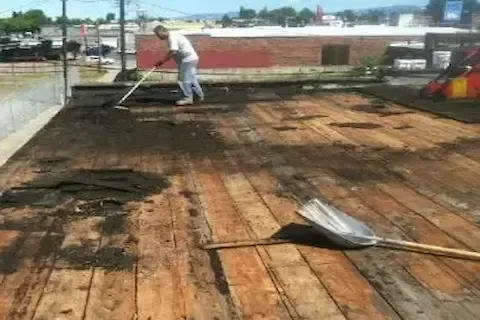
Re-Roofing vs Replacement on Maple Grove Commercial Roofs
At some point between year 15 and year 22 on a flat or low-slope commercial roof, most Maple Grove building owners face the same uncomfortable question: do you add another layer on top of what's already there, or do you tear everything down to the deck and start over? Both paths cost real money. Both carry real consequences. And the wrong answer can lock you into another round of repairs within five years, or cost you significantly more than necessary if you tear off a roof that had useful life remaining. The goal here is to give you a clear framework for making that call before you're standing in front of a contractor with a pen in your hand.
What Re-Roofing Actually Means on a Commercial Flat Roof
Re-roofing, sometimes called an overlay or recover, means installing a new membrane system directly over the existing roof assembly without removing what's underneath. On a commercial flat roof in Maple Grove, this typically involves adhering or mechanically fastening a new TPO, EPDM, or modified bitumen membrane over the existing surface after thorough cleaning and preparation.
The advantage is straightforward: you skip the most labor-intensive and disruptive part of a full replacement. Tear-off generates significant debris, exposes the interior to weather during the process, and adds disposal costs. An overlay eliminates all of that. Labor time drops. Cost per square foot drops. Business disruption drops.
The limitation is equally straightforward: you can only do it once. Most building codes, including those applied in Hennepin County, allow no more than two roof assemblies on a structure at any time. If your building already has two layers, you have no legal path to a third. Beyond code, adding weight to an existing structure has load implications that need to be evaluated before any overlay decision is finalized.
When Re-Roofing Is the Right Call
Re-roofing makes sense under a specific set of conditions. If your existing roof has only one layer, if the insulation beneath the membrane is largely dry and structurally sound, and if the membrane failures you're experiencing are surface-level rather than systemic, an overlay can extend your roof's serviceable life by 15 to 20 years at a fraction of full replacement cost.
The honest diagnostic question is this: where is the water going when it gets in? If leaks are traced to seam failures, flashing deterioration, or isolated membrane punctures, those are surface-level problems. If moisture has migrated into the insulation board itself — which infrared scans and core samples can confirm — then covering that wet insulation with a new membrane traps the problem underneath and accelerates the deterioration of both the deck and the new system you just paid for.
For Maple Grove commercial properties that operate through Minnesota winters, trapped moisture is not a minor issue. Freeze-thaw cycling across the Maple Grove area means water that enters insulation in October expands repeatedly through December, March, and sometimes April. That mechanical damage compounds every season.
If a moisture survey comes back showing less than 25 percent saturated insulation, most roofing professionals will consider that a reasonable candidate for overlay. Above that threshold, the calculus shifts hard toward replacement.
When Full Replacement Is the Only Defensible Option
Full replacement becomes necessary in several situations that have nothing to do with personal preference or budget tolerance. The first is structural: if core samples or visual inspection reveal deck damage — rotted wood, corroded steel, compromised concrete — you cannot safely install any new roof system without addressing what's underneath. An overlay on a compromised deck is a liability, not a solution.
The second situation involves existing layer count. As noted, two layers is the maximum. If your building already has an overlay from a prior owner or a prior decision cycle, your only legal option is full tear-off.
The third involves warranty requirements. If your business requires a manufacturer-backed warranty — for tenant lease compliance, insurance requirements, or asset management standards — most manufacturers will not issue a full NDL (No Dollar Limit) warranty over an existing assembly. They want to warrant what they can inspect from the deck up. Full replacement is the only path to that level of coverage.
For Commercial Re-Roofing Services that are properly scoped from the start, the difference between a well-executed overlay and a premature one is often a decade of roof performance.
Budget Realities for Maple Grove Building Owners
The cost gap between re-roofing and full replacement is real, but it narrows when you account for all factors. A straightforward overlay on a 20,000-square-foot commercial flat roof in the Maple Grove market will typically cost 30 to 50 percent less than full tear-off and replacement of the same area. That difference is meaningful.
But consider what you're buying with each option. A well-executed overlay on a sound substrate gives you 15 to 20 years of additional service life. A full replacement on a building with deck issues you didn't address gives you 5 to 7 years before you're back in the same conversation. The cheaper option is not always the lower-cost option over a ten-year horizon.
Maple Grove commercial property owners who are carrying the building as a long-term asset — rather than positioning for near-term sale — generally benefit from replacement when the roof is at or past its actuarial life expectancy and when moisture readings are elevated. The 15-year NPV of avoiding a second major roofing event almost always outpaces the upfront savings of the overlay.
Owners planning a sale within three to five years face different math. A properly documented overlay with a transferable warranty can satisfy buyer due diligence and preserve more capital for other priorities.
The Inspection Process That Determines the Answer
No contractor should recommend re-roofing or replacement without completing a proper diagnostic sequence. That means a visual inspection of the membrane surface, flashings, penetrations, and drainage. It means an infrared scan — ideally conducted on a clear night following a warm sunny day to maximize thermal differential. And it means core samples at representative locations across the roof field to assess insulation condition and moisture content at each layer.
In Maple Grove, where many commercial properties along the Elm Creek corridor and the 494/169 interchange area were built during the same 1990s and early 2000s development wave, you frequently find roofs entering their end-of-life window at the same time. That's created a market where some contractors are moving quickly and not always completing full diagnostics before making recommendations. Insist on the full sequence before any scope is written.
The roofing decision you make now will outlast most of the other capital decisions you make this year. Read the building first, then read the budget. Understanding the full picture is what the guide on commercial re-roofing building owners covers in additional depth for those who want to go further into the ownership considerations.
What to Ask Before Signing Anything
Before you authorize any scope of work, get clear answers to these questions from any contractor you're evaluating. Did they complete an infrared scan, or are they estimating moisture conditions visually? How many layers are currently on the roof, and have they confirmed this through core samples? What warranty will be available, and is it manufacturer-backed or contractor-only? What is the load calculation for the overlay, and has it been reviewed against the building's structural documentation?
A contractor who can answer all of those questions with documentation is a contractor worth trusting with a decision that will affect your building for the next two decades.
